
Over the weekend of 10-11 October 2026 I took part in hackTurin 2026 together with Giacomo Lisita, Lorenzo Palloni and Federico Nebuloni. We tackled the Beyond Solar challenge with PoopVolt, and the official writeup is on Devpost.
This post is not about the pitch. It is about how we built it: a weekend in which coding agents were not a gadget on the side but full participants in the repository, and in which the most useful thing we taught them was to say what does not work yet.
The idea in one paragraph
The owner of an older photovoltaic plant usually cannot tell whether it still produces what it should. Dust, bird droppings (hence the pigeon) and ageing lower the output slowly, and a plant that “apparently works” is rarely inspected. PoopVolt is a proposed Edge AI maintenance aid built around an Arduino UNO Q: it compares expected and observed production, classifies visible soiling from a phone photo, and gives a service company evidence that a technician reviews before proposing an intervention to the owner. Everything is in the public repository B-AROL-O/hackturin-2026.
The numbers behind the weekend
The first commit landed on Saturday at 01:25, a few hours before the hacking started. By Sunday afternoon the repository had:
- 83 issues and pull requests, and two tagged releases (0.1.0 at 07:39 and 0.2.0 at 08:25 on Sunday morning);
- 134 non-merge commits, 87 of which were authored or co-authored by Claude Code; a handful more came from OpenAI Codex and the GitHub Copilot coding agent;
- firmware for the UNO Q microcontroller and Linux side, a SOLARMA inverter log importer, an expected-versus-observed comparison, a phone-to-edge inspection workflow, a live dashboard, a KiCad schematic, a bill of materials, brand guidelines and a 120-second Remotion motion-graphics film.
Four people could not have typed all of that in thirty-something hours. Four people directing agents could.
Who did what: humans and agents
We did not plan a formal division of labour, but one emerged quickly, and each of us ended up pairing with a different kind of agent.
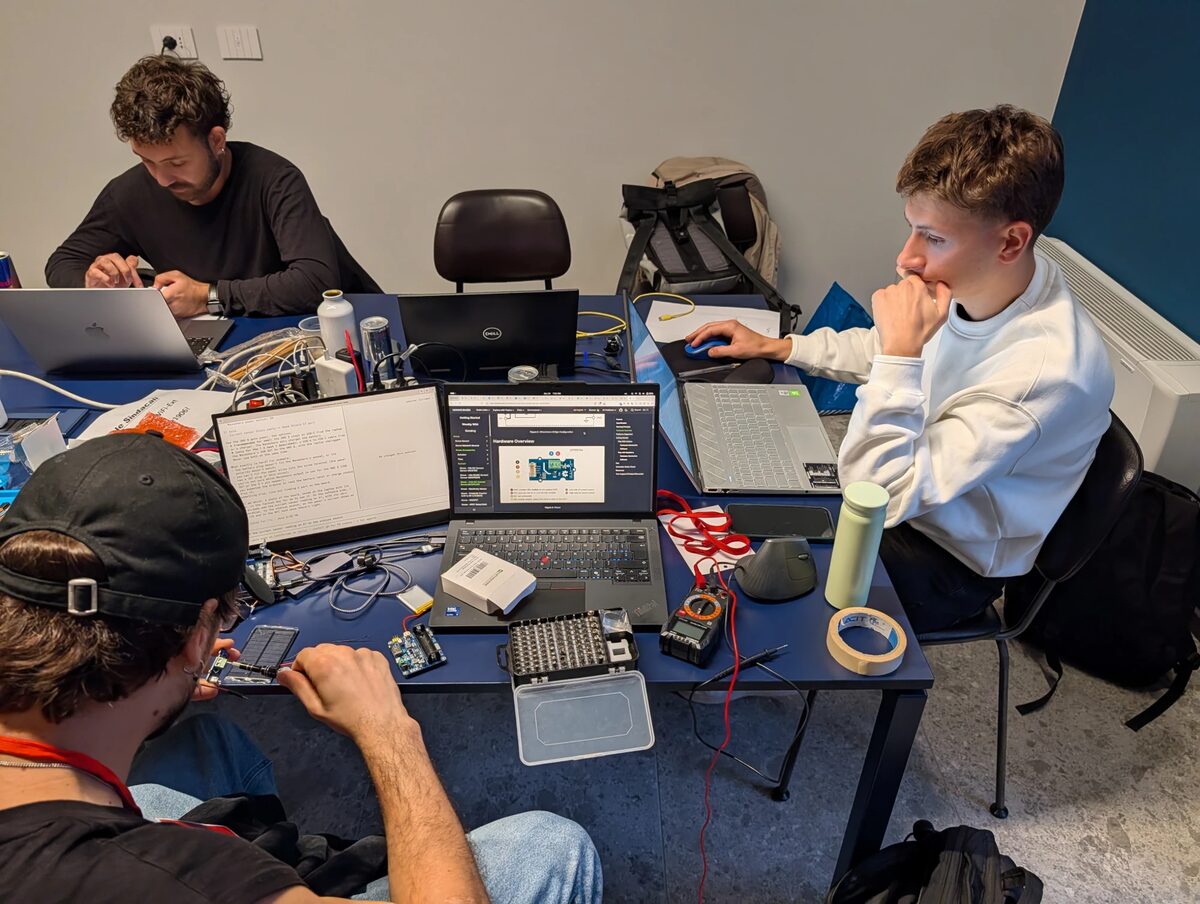
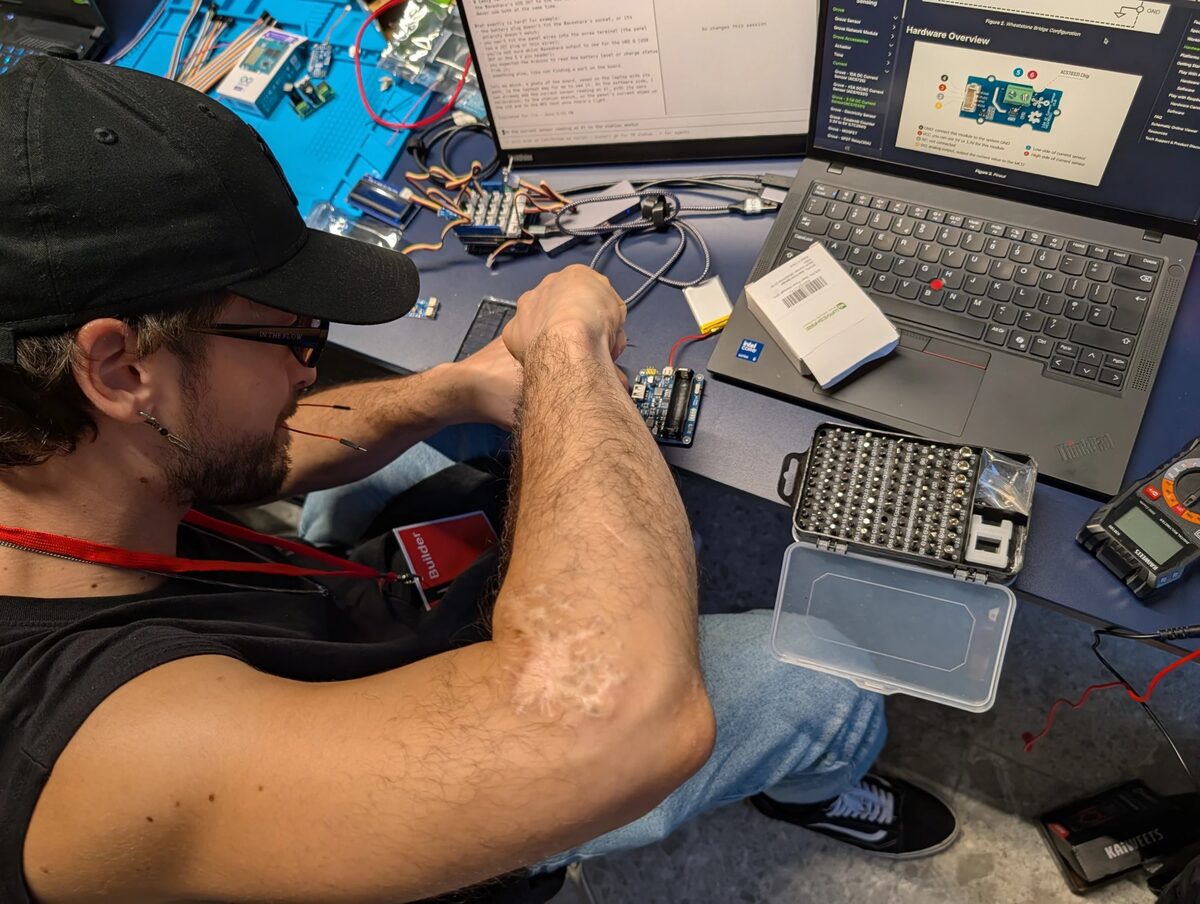
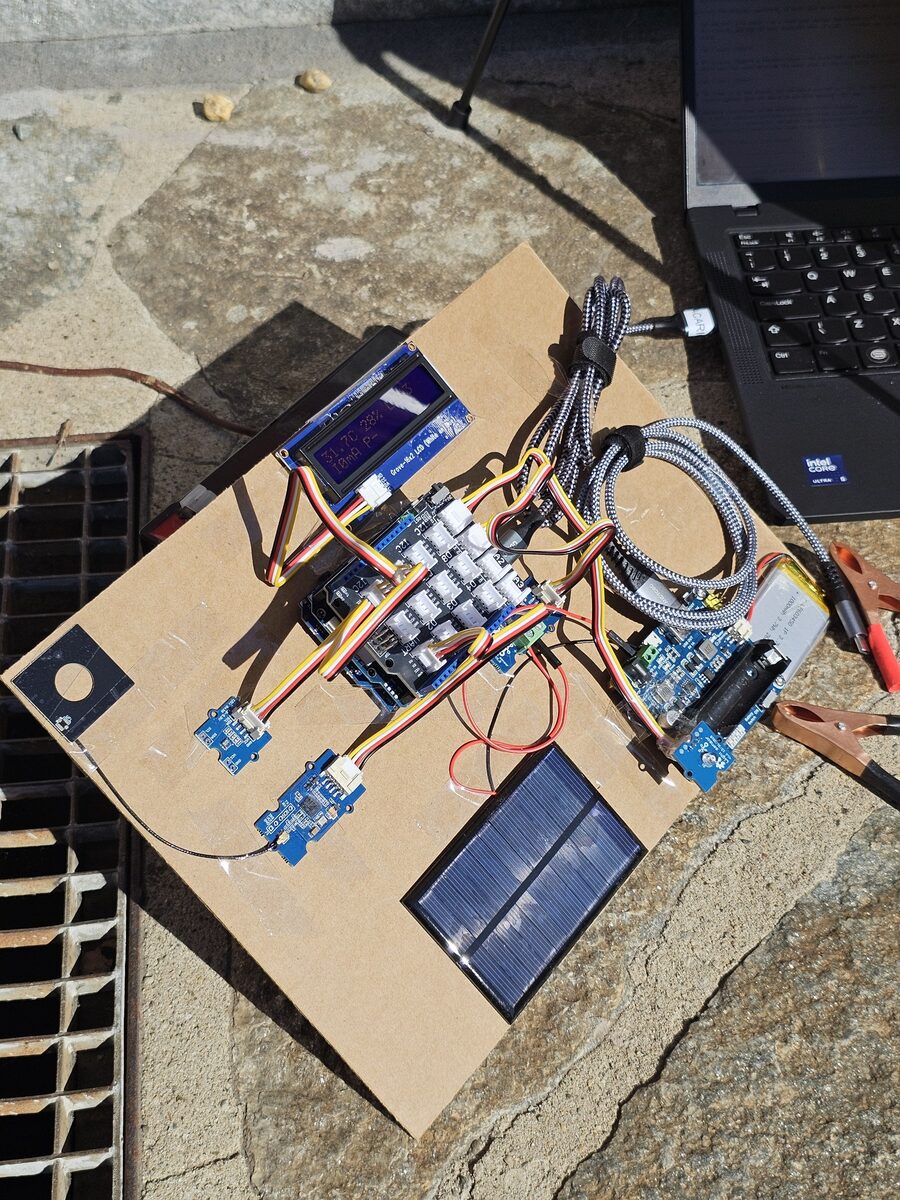
Lorenzo stayed close to the metal. The firmware commits are his: Grove
sensor diagnostics on the UNO Q Base Shield, the PN532 NFC reader over the
shield UART, panel current on A1, streaming readings from the MCU to Linux over
the Bridge, and a measured storage/RAM/CPU budget for a computer vision model on
the board. Hardware does not forgive hallucinations, and this is where the
humans did most of the work, measuring and writing down what they measured: the
repository even records that the LM2596 step-down converter could not supply
5 V from the LiPo battery.
Giacomo owned the story: the pitch, the architecture documents, the
company offer and, at the end, the film. He worked largely with Codex (you can
still see codex/... branches in the history), and he invested early in
something I had not seen before at a hackathon: an
.agent/ guideline corpus
plus an AGENTS.md at the repository root. They tell any coding agent what to
read before touching the presentation, which documents are authoritative and,
above all, to keep “architectural proposals, illustrative examples, and
measured results distinct”. The Remotion film was then produced from a written
storyboard, a frame-accurate timing.json and a ready-to-use
coding-agent task.
Federico gave PoopVolt a face: the logo, the brand guidelines and the prototype photos used throughout the video.
I mostly acted as the integrator, with Claude Code
running as a long-lived cloud session (a similar setup is described in
my previous post). On
Saturday morning it replaced Poetry with uv in the devcontainer; later it
wrote the SOLARMA inverter log importer with unit and timestamp checks, the
bill of materials, the Devpost draft and the
project status
page. In the small hours of Sunday it produced the peer-relative
expected-versus-observed comparison on the replayed data, which became the core
of our evidence.
The night shift
That 03:07 commit deserves a paragraph of its own. While the team was asleep, the agent was replaying months of inverter logs from a real plant and looking for the case that would make the idea tangible. It found one: inverter 1 produced nothing for 75 days, about 550 kWh short of its peers, and a simple daily peer check would have flagged it on the first day.
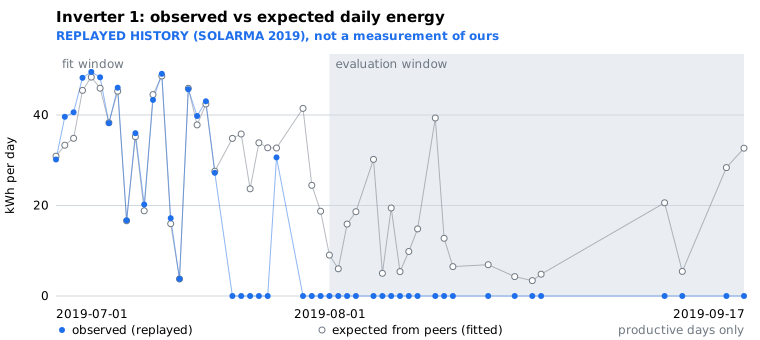
When I woke up, I reviewed and merged it, cut release 0.1.0, asked for a requirements check of the Devpost draft against the Beyond Solar brief and cut 0.2.0 before 08:30. Having an agent that keeps working on a well-defined task overnight, and a human that reviews in the morning, turned out to be the most productive rhythm of the weekend.
Guardrails that made it work
Letting several agents and four humans push to the same repository for thirty hours could have been chaos. A few rules, set up in the first hours, kept it under control:
- Everything goes through pull requests. Work happens on feature branches
merged into
develop;mainonly receives release PRs. - Linters as the referee. We run
Super-Linter on pull requests
to
main, with markdownlint, Prettier, textlint terminology rules, pylint, Biome and stylelint. A good share of the agents’ commits are boringchore(lint)andstyle:fixes, and that is exactly the point: the agents cleaned up after everyone, humans included, so that every release PR was green. - A devcontainer for everybody. The same
uv-based environment, with Claude Code preinstalled, worked on laptops and in cloud sessions alike. - Write the brief down.
AGENTS.md, the.agent/corpus, the storyboard and the agent task files are prompts that live in the repository, are reviewed like code and are shared by every agent, whichever vendor it comes from.
Honesty as a feature
If you read the PoopVolt readme you will notice an unusual amount of qualification: “proposed”, “replayed”, “simulated”, “remains to verify”. That was deliberate. Coding agents are very good at producing confident text, and a hackathon pitch is the perfect place for confident text to drift away from what the prototype actually does.
So we made the distinction part of the rules. The project status page lists what works today and what is still a proposal. The data on every chart is labelled measured, replayed or simulated. When we discussed our progress with Matteo Stoppa of Coesa, one of the mentors, on Saturday and Sunday, the Devpost draft was updated to say “discussed with”, not “validated by”. Once the rules were written down, the agents applied them to the documents they touched, just like the linter rules.
Lessons learned
- Agents scale the boring parts. Lint fixes, merge conflict resolution, changelogs, character counts in the Devpost short fields: none of it is glamorous, all of it would have cost us hours.
- Humans own the physical world and the claims. Wiring, measurements and the decision about what we can honestly say stayed with the people in the room.
- Long-running sessions beat one-shot prompts. A single cloud session that knew the whole repository history was more useful than many short chats.
- Vendor diversity is fine if the brief is shared. Claude Code, Codex and Copilot all worked on the same repository without stepping on each other, because the rules lived in the repository rather than in anybody’s head.
What’s next
The repository is still alive after the event, with a few more PRs merged in
the following days to keep main green. If you are curious, have a look at
the Devpost page and the
repository, and let me know what
you think.
Many thanks to the hackTurin 2026 organizers, partners and mentors, and to Giacomo, Lorenzo and Federico for a great weekend.